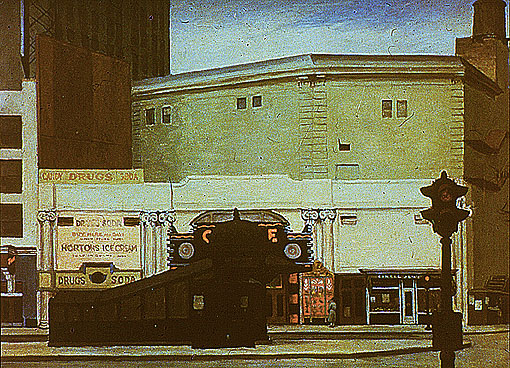
The city defeats the eye's reach. Circle Theatre(1936) makes the
case explicitly; it could be argued that this is the
quintessential Hopper painting. With obvious deliberation, Hopper has
chosen a subject which he does not let us see. The theater and its
entrance and its name are hidden. Indeed, the elaborate, painstaking
manufacture of concealment is the painting's most notable achievement.
Furthermore, the object that interrupts our view is a subway kiosk, a
stairway whose entry we also cannot see, and which leads -- significantly
-- not up, but down.
 |
| Edward Hopper, Circle Theater
(1936) |
With perfect logic, Hopper hated skyscrapers. From the Woolworth and
Singer buildings that went up before the First World War, to the Chrysler
and Empire State buildings of the early 1930s, a collaboration of pride,
technology, and money changed the face of New York almost daily. And, as
Ann Douglas reminds us, most New Yorkers thought that the skyscrapers
would be as transient as the structures that had been torn down to make
way for them (Terrible Honesty,p. 437). Hopper simply erased
them, and with them the restless energy they symbolized.
 |
| Edward Hopper,
Chair Car (1965) |
Along with the skyscrapers,
he rejected virtually every hallmark of modern urban experience: its
acceleration and disorder, its irredeemable transience. The men and women
in Hopper's paintings are carved in the granite of their solitude. They
are, quite obviously, going nowhere, anchored to their spaces, permanently
motionless. They are immobilized, not just as a consequence of Hopper's
static medium but as the definition of their very being. If there are
windows, there are few doors. In Hopper's pictures, doors are
conspicuously missing even when they ought tobe present, as in House by
the Railroad. And in at least one famous case, Chair Car
(1965), a
door without a handle turns what ought to be an opening into a blank wall.
previous frame
 next frame