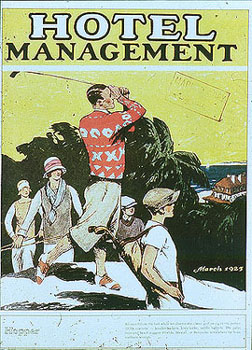
cover by Edward Hopper
|
| Hotel Management, March 1925, cover by Edward Hopper |
The truncated, claustrophobic interiors of Hopper's most distinctive pictures express his revenge on his own earlier work. He answered his peppy drawings, which had held out the promise of abundance, with images of diminishment, loss, and deprivation. It is not that the people in Hopper's city paintings seem actually poor. But their spiritual vacancy testifies to an impoverishment that transcends matters of class.
Hopper's underfurnished, spooky rooms are also a strategy of control, a way of managing urban turmoil by denying it. The recurrent keynote of nineteenth-century landscape painting had been the horizon, stretching as far as the eye could see. The horizon, emblem of limitless space and unprecedented mobility, survived at least in shrunken form even in the cityscapes of Hopper's predecessors, in the work of John Sloan, whom Hopper admired [JEFFERSON MARKET], and of George Bellows, whom he considered a rival [LONE TENEMENT].

 next frame